
Impossible Bodhisattva
A Eulogy, A Contemplation on Helping Someone Who Can’t Be Helped

Dear Friends,
I was planning to republish the below re-edited piece (the original was written in 2019) to commemorate the birthday of my deceased childhood best friend, which is today. The piece is part eulogy, and part meditation on the limits of our duty to “help.” Then, in the weeks leading up to now, death—early and unexpected death— has visited my social circles in various forms, so putting this piece back out there felt more appropriate.
As for my friend, colleague, and the subject of a recent episode of The Road Home podcast, Ralph De La Rosa, I received a bit of poignant news last week. Both of our most recent books (My book Confidence and Ralph’s book Outshining Trauma) were awarded gold medals in different categories in the 2025 Nautilus Book Awards. It felt poignant to share the recognition with a friend gone too soon (whatever that means).
If you’d like to read it, my essay “Impossible Bodhisattva” is below.
Impossible Bodhisattva
For Michael Wesley Klein
May 27, 1977 – January, 2017
Months after your death, I thought I saw your name in a Daily News article. Sadness swarmed again. The article wasn’t about you. There haven’t been any articles about you, Michael. You’ve remained profoundly un-eulogized. The Daily News piece simply included a witness to a separate event who almost exactly shared your full name. Seeing your name out of context made my body stop and my lip quiver, even though the article itself was a rare cause for celebration during the unending media dumpster fire of 2017. The Daily News had recently transformed itself from outright tabloid into a progressive beacon, its covers giving hope and cartoonish humor to an era in which similarly cartoonish villains had overtaken most of our clickable stories. For once, the media did not fondle our amygdalae inappropriately. Instead, The Daily News delivered a “good samaritan” tale from a speedy metropolis, reporting an act of fearless compassion. It told the tale of an Impossible Bodhisattva. The whole thing was witnessed by a woman named Michal Klein. Obviously, she wasn’t you. I misread the page. You were long gone.
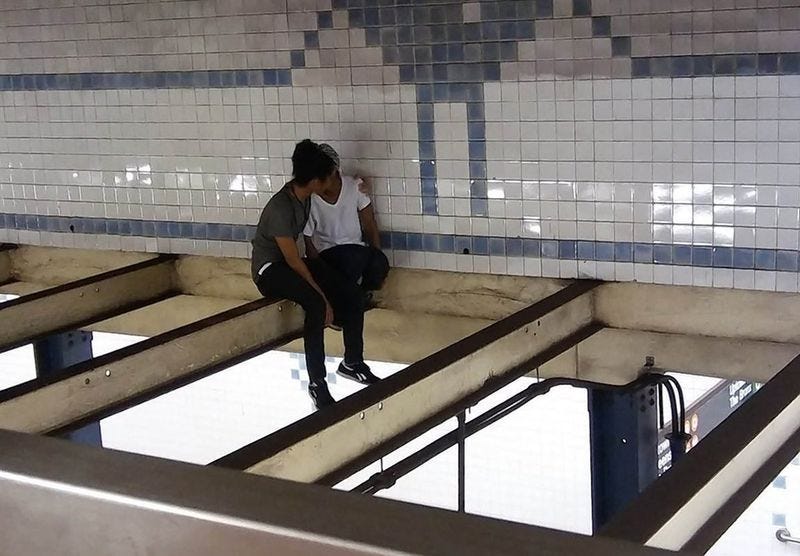
(Photo of the Impossible Bodhisattva via Michal Klein on twitter)
Perhaps I needed that other story to cross my path, not for its compassionate inspiration, but because I needed its spark to rouse from the numbness I felt about what happened to you. I had no idea how to write a remembrance of you, at least not without gaps in your timeline so long as to render my memorial painfully incomplete, if not outright irresponsible. I knew you so well once, back in that day. Regarding your adult life, I know the vague algorithm of your suffering, but not the specificity of its slog. Because of what I do, I hear stories of death regularly. But your death was brand new to me in two ways: 1) You are the only person I ever called best friend who has died and 2) You are the only person I know who died as alone as you did: the loneliness that swallowed your final years must’ve been enormous.
I want to construct a fictional dialogue between the two of us from within your bardo, your body-dissolved space, to ask what it’s like to die. I know 14-year-old “you” could describe it with a goofy poetry which I miss more than anything. Maybe you’d take a cheesy Mariah Carey song and replace the lyrics with scatological references to the dying process, singing about the embarrassments of decay, something about *literally* losing your shit, crooned in one of your eccentric impressions of a pop-diva. My imagination wants to set-design for this fantasy chill session of ours, a backdrop peppered with posters from our shared childhood, perhaps X-Men, A Tribe Called Quest, and Garbage Pail Kids for irony’s sake. I want you to say something nonchalant about your experience of dissolution, like you would have in eighth grade, only with a 40-year-old’s vocabulary.
Maybe in this bardo scene we’re buying Dungeons & Dragons figurines and dice-bags at that old role-playing store in midtown Manhattan (questioning why “charisma” was even an attribute in role-playing games, given how uncharismatic it was for us to play them, long before Game of Thrones made interest in fantasy realms acceptable for the “cool” kids). Maybe we’re making a VHS documentary interviewing strangers with subtly inappropriate questions in Riverside or Washington Square Park. Maybe we’re interviewing each other on the tastes in art and literature we each developed much later on, or maybe I’m telling you about my wife and daughter, who you never had the chance to know, who I most likely wouldn’t feel comfortable meeting the grown-up you. Maybe you’re telling me, like so many other old friends when we cross paths, about that one time you tried to meditate. Maybe you’re just bringing me fully up to date on your 20s and 30s, and somehow in this imaginary scenario you manage to tell me about noteworthy and even fulfilling times in our absent decades — those decades where, for most of us, the cache of stored knowledge automatically builds, but where wisdom’s growth is very optional.
In this scene I’ve staged, the retold events of your adult life would sound much more entertaining and less painful than I know they must’ve been. But my imagined dialogue would be indulgent and sloppy, the product of some creative writing seminar I never made it to. It would be too easy to hypothesize a frame for your unframeable experience, a conceptual mistake which my tradition considers the ultimate arrogance. Reality has guillotined any chance of dialogue. There’s no one left to ask about your state of mind, and your state of mind is no longer “yours,” anyway.
You were found dead in a fast-food restaurant, several months before you would’ve turned 40. Heroin and alcohol overdoses were the cause. Your first liver was already taxed into oblivion, transplanted a few years before, or so I heard. Another friend of mine died from accidental fentanyl within an opioid cocktail the same year — a respected Zen teacher and activist who shared your first name, no less. Did that same substance hit your bloodstream, breaking the electric currents that animated you? We learned about your death secondhand, through a friend of a friend, apparently one of the few people still in touch with you, the few people you hadn’t driven away completely during decades of addiction.
My thought echoed as I stood outside in late winter air, listening to a recorded message describing the discovery of your body:
My best friend died all alone in a FUCKIN Mickey D’s.
You and I were practically joined at the hip for four years, fifth grade through eighth. We were classmates and friends longer than that, but we were an inseparable duo for those four. You led, I followed, alpha to the beta, the already-bloomed and the late bloomer, you the proactive and I the reluctant, an eccentric daredevil and his occasionally witty sidekick. Your mischievous spirit never turned to outright malice toward anyone, setting the perfect tone for our progressive school. You were friends with everyone in our diverse class, male and female, and when new kids showed up each year, you made them feel welcome instead of hazed. Parents asked after you; teachers liked you even when you drove them crazy, because they respected the cognitive skills you displayed while undermining lesson plans. Having been left back in kindergarten, you were a year old for our class, so you were ahead of the game in a lot of ways. And you were quietly romantic. Our classmate Isa remembers you slipping her a love note, including a scribed EE Cummings poem that you saw in a Woody Allen movie. Quite the literary feat for a fifth grader, you stealth Romeo, you.
You had a late-teen air about you, even in Junior High School, and bore a mild resemblance to River Phoenix, which would make me Wil Wheaton in our big city reenactment of “Stand By Me”. You were the reason my constant fear of getting jumped by bigger, badder kids on the way home from school was anything close to manageable. And you had your personal fashion, a tight-fitting hodgepodge of popped preppy collars and punk jeans which no one would dare diss, even as the rest of the boys in our grade opted for baggier pants sunk low, donning the Starter caps of sports teams we weren’t even rooting for, that early 90s hip-hop style that dominated our shared moment. In 7th grade, our teacher — trying way too hard to speak in something resembling our vernacular as we complained to him about workload — would tell us to ‘just deal.’ One day you waited on pins and needles for him to say his catchphrase. When you heard the words, you plucked a deck of playing cards from your back pocket and started distributing them around the large table of the seminar-style classroom. Our teacher’s face froze at your preternatural comedic timing for five full seconds as laughter infected the room.
Another time, you spontaneously led the entire class onto chairs and tabletops in a Dead Poets’ Society reenactment for the same outmatched teacher, who again froze in paralyzed protest, another perfectly timed victory for benign chaos over imposed order. I don’t even think he reprimanded you for that one.
Oh homie, my homie.
Regarding your home, there was much that was visibly confused and confusing to my adolescent brain, even if I couldn’t label the suffering precisely in 8th grade. Even as kids and adolescents, friend who visited your apartment would note the obvious discord of your family unit. The whole thing made little sense. Your uncle is one of the most famous fashion designers in history, yet your father, his brother, drove a New York City taxi cab. To us, this family arrangement — the combination of fashionista celebrity with working class credibility — was both very weird and very cool. We never got any free clothes from your family connections, although your cousin, then a producer at Saturday Night Live, did get four of us 2nd row seats to watch an SNL recording in 8th grade. Sharon Stone and Pearl Jam were the hosts. We never met your uncle, and for that matter, we rarely saw your father. You would frequently comment, at age 14, about your father’s gambling addiction which had prevented him from securing another taxi medallion so you could move on up to a nicer apartment. Your mother always seemed desperate, erratic and grasping for human attention as she chain-smoked on the living room couch, and she would keep your friends on the phone for long periods of time when we called looking for you, as if she, not you, were our friend.
One night when I was over for dinner, your father was, for once, not out driving his cab or somewhere else in his secretive life. Your parents were in the midst of a World War I style fight, trenches dug years prior, mustard-gassing each other with glances and asides across the table. At one point your father leaned over to your mother and said, loud enough for us both to hear: “As soon as he leaves for college, I’m outta here.” You just quietly petted your Boston Terrier, who sat following her own panting breath under the table, an anxious canine meditation. She was the most stable sentient being in the apartment.
At the start of high school, we went our separate ways. Little did I know then that this would be the last time I would ever refer to someone as “Best Friend” without qualification, without contextualizing their location within life’s many social orbits. Later on, I’d say things like “My best friend from college is a filmmaker” or “she’s the first close friend I made after college” or even jokingly “I gotta go see my Hetero Life Partner.” But there would never be a monolithic entity unreservedly called “Best Friend” again. Everyone who came after you would have a place among places, a role in context, a proximity, never a singularity.
For high school, I stayed in the city; you went to boarding school in Pennsylvania, using your family connections to escape the daily abrasions of your family. We only chilled very occasionally. Senior year you came downtown to my apartment when my father was away and I was throwing a party. You told me you now went by your middle name Wesley, or Wes, instead of Michael. I defiantly called you Michael, nostalgic for the times when you would’ve informed me of such a crucial decision long before it went public. If only I could have attuned to all your erratic behavior at that party! At the same moment, one of my closest high school friends was diagnosed bi-polar and institutionalized for 6 weeks after the unfolding of an epic manic episode which rocked our whole high school crew. The lithium they prescribed made him gain 30 pounds over those six weeks, and he spoke slowly after re-emerging, his voice like a crinkled cassette whose sputtering tape had been salvaged and rewound by hand. If only I knew the signs, I could’ve spotted much of that same volatility in you. But what did I know? And why would I have taken on the burden of knowing it back then, anyway? You seemed ok that night, your social confidence more robust than mine, as usual, and you rolled into my father’s loft with a mysterious girl whose own banter was slick and captivating. For an 18-year-old straight boy, what greater sign of a friend’s well-being is there than that?
After college, all your elementary school friends knew something was wrong, but none of us were in contact with each other enough to coordinate checking in on you. Sometime after 9/11, you flaked on showing up to meet with mutual friends in Union Square. Then my mother swore she saw you panhandling on the subway, excuse-me-ladies-and-gentlemen-ing the car, selling pencils, of all things. Mom swore you recognized her and jetted to another car before she could say anything to you. Since she hadn’t seen you in at least five years, I hoped she had mistaken you for someone else, but her eyes were credible. A mother’s facial recognition software usually withstands the test of time.
Fast forward beyond the long gap, the span of your family strife and addiction, that chasm of isolation and who knows what else. Fast forward through those decades in which my own life’s atmosphere was increasingly privileged by community and friends, teachers and teachings, where tools were offered to me to work with my existential struggles, the very same lack of tools robbing you of your adult life. I am grateful for so much during the time we didn’t know each other — I wonder what minor gratitudes and major gripes fueled your worldview over those years. I wonder what vocal tone your inner critic spoke with — the voice that systematically drove you away from everyone who loved you. My own inner critic has gradually become a playful muppet within my skull, a character I sometimes make the mistake of taking seriously. Your inner critic must’ve been a horror movie, a multiplexed bloodbath.
Here is what I know secondhand about the end of your days in this body. You died so alone. You were without home for the last few years of your life, losing both your Brooklyn apartment and your transplanted liver to your addiction. Your mother was already gone from her own liver complications; your father had picked you up at least once and helped get you into a halfway home. The rest of your family was out of the picture, cutting you off from the frustrations of support which maybe they concluded was only enabling your addiction further. You died so alone that only a small group of your childhood friends even caught word of your death, through the various leakages of the social network. You died so alone we weren’t even sure if the memorial we attended was meant for you. You died so alone you didn’t have anyone to relate to the details, closing the book on your life.
You died so alone that no one even bothered to deactivate your Facebook profile.
During that 15-year gap where we didn’t know each other, you reached out to me via that profile. It was 2010 or 2011. You messaged me a bunch, told me that you had seen my first book in a bookstore and you also thought what I was doing was wonderful. Maybe we could get together sometime and discuss everything. I think you even proposed getting tea, assuming tea was the Buddhist beverage of choice. I said of course, without giving you my number. As I probed your profile photos and read your messages, I knew life was still not treating you well. I didn’t ask about your mother or father. I could’ve opened to you more. But I chose to interpret your written words as unbalanced and unreliable, without delving much deeper, even though I know that the tendency to suspiciously interpret digital words is one of the greatest obstacles of our technological moment. I tell my students we should attempt to speak to someone in person before assessing their intention, unless you’re certain they’re trolling or harassing you. That’s the kind of thing I say to people, Michael. I decided not to meet you. Something was telling me: “stay back.”
Of course, that’s not how I rationalized backing off when you reached out. I was busy. I was very busy, long days working with people’s minds and being present for others, a grown-up extroversion that never felt natural to me in childhood. I’ve had to slowly learn how to “just deal” with myself and others simultaneously. This adult persona of mine may have surprised you. Perhaps the discovery of my unforeseen career path led you to reach out in the first place.
Hearing from you activated my compassion fatigue: that moment we just can’t stretch our psychic resources for one more person in need, when the commitment required to make any reasonable difference feels so all-or-nothing, leaving us too depleted to imagine any middle ground along the vast spectrum of ways it’s possible to be present for another person. In those moments that giving “everything” feels like more than we have in the tank, we shut down and do nothing, or rather, nothing uncomfortable. We pretend there’s no other option than a wistful shrug at the suffering being who is right here, right now. We do it to unhoused people all the time, and you were one of those in your later years, weren’t you, Michael? In my mind, I responded to your implicit request for help with the internally coherent but externally bizarre premise: “I’m too busy helping people to help you right now.” The crafting of the mind’s justifications is painful to step back and re-examine, which is exactly what grief impels me to do.
I’ve had to question my bodhisattva vow. You didn’t even know what a bodhisattva is. Or maybe you did, how would I know? Maybe one of my parents mentioned the term to you, or maybe you took a class on Buddhism at boarding school or your brief time in college. The Beastie Boys even wrote a song about it. Yet another thing we didn’t share — I don’t remember if you liked the Beastie Boys. You may’ve had a perfectly complex criticism of their white hip-hop identities. You may’ve been totally joking about said critique. You may’ve said nothing about them at all. Memory is a frenzied hologram.
A bodhisattva is an archetype of compassion who has committed to stretching beyond egoic limitations to help others. After they make a commitment to their own path, they commit to doing whatever they can for others along the journey. By proclaiming a purpose that is about more than just the constant defense of self-image, they begin to eradicate the self-fixation which turns other sentient beings into mere satellites in their gravitational orbit, gradually liberating from the fhierarchy of self and other altogether. In a life based only on self-preservation, other humans become props, useful in relation to either the promotion or insignificance of a narrative called “Me.” The self-centered life is a perpetually anxious one, a life where “I” remains walled off from others, defended at all costs. The self-centered approach constantly turns others into saviors and evil-doers, and no sentient being is either of these. Meanwhile, all other beings, those deemed irrelevant to “Me’s” survival, become marginalized, unpaid extras on the film set of life.
The bodhisattva vow invites us, step-by-step, to begin occupying the heart space where self and other become equalized. It is only in this space, according to Buddhist philosophy, that humans become fully awake and alive. In this space, we encounter our identity in a more fluid exchange with the world “out there,” supported by generative exercises in empathy and love. We practice slowly visualizing the shared experience of what it means to feel, struggle, suffer, and find joy as another. By committing to this mental exchange of one’s experience with others, by increasing confidence in our ability to alleviate suffering, the defensiveness and anxiety which amplifies so much of our social stress relaxes a bit. Building walls between self and others, it turns out, is far more expensive than inviting others into your journey.
Classically, the details of the Bodhisattva vow are presented in terms that sound functionally impossible, referring to the limitless number of sentient beings dwelling in strife or confusion, who we are called up to help. Saving all sentient beings from the torment of their own confusion and the torments of an oppressive world? It’s impossible, Michael. And it is exactly this impossibility that, by taking the vow, we are invited to let baffle us a little bit. But it’s not supposed to feel Sisyphean. Vow or not, we can each only do what we can, and we each have to care for ourselves. Yet, in accepting the vow, we begin to stretch beyond perceived limitations, and year by year, more openness becomes possible. Like any healthy physical stretch, you begin to feel more fluid, stronger, and maybe even…happier.
Solace comes in conversation with a close friend, a therapist specializing in addiction and helping the adult children of addicts. Even if I had offered myself to you more fully when you reached out, it probably would have done no good, she tells me matter-of-factly. She reminds me what I already knew, that serious addiction is interconnected with an intensified experience of isolation. Addiction is like a snake eating its tale, an increasingly confined cycle, she says. Each moment of synthetic bliss fades back into abandonment more rapidly, leading more quickly to shame and painful unworthiness, which triggers the next need for a fix, which leads further away from human connection. For the true addict, my friend reminds me, intimacy is to be avoided at all costs. You disappoint others so they won’t see you. You make yourself live perpetually just beyond the reach of those who might reach out. It’s strategic. She thought that even if I agreed to meet you, you probably wouldn’t have showed up. Or if you did, you would have performed an act of sabotage to drive me away for good.
Checking your posthumous Facebook wall offered a memorial of exactly this cycle of isolation over the last five years of your life: all the friends, most of them unknown to me, leaving unanswered messages for you, posting things like “Thinking of you today…” and “where are you my friend?” and “we want to see you” and “bro reach out to me dog otherwise I’m gonna come look for you man” and one perfect post on your wall speaking the question we all need to vocalize more often in this age, whether or not we have the time to spell out the words fully, whether or not the person they are directed toward ever responds:
“How r u?”
My conversation with my therapist friend soothes me. After all, she has also taken the bodhisattva vow. I remind myself and others all the time: being a bodhisattva doesn’t mean being a doormat. Be compassionate, don’t be reckless. Learn to speak up for yourself before you give all your resources away. You can’t help people if you have no energy yourself. You can’t help someone if they’re manipulating you. Compassion never means enabling. And if you have a background of trauma, you need to be cautious about this whole bodhisattva endeavor. Regardless of your history, sometimes the most important word in the English language for a wakeful person to speak is NO.
These are the things I say to people, Michael.
But now that devil is advocating big-time within my mind. Maybe our problem is not capitalism, maybe it’s not the GOP; maybe it’s the generations of half-assed, play-it-safe bodhisattvas like me, those of us who like to talk about keeping good boundaries for compassion when we’re really just terrified of vulnerability. Maybe all this bet-hedging compassion has delivered the world to those clunky villains who now dominate our landscape. Perhaps being reasonable, rather than principled, hesitating instead of leaping, will soon flush our whole society down a golden toilet.
And here’s that Daily News article, staring at me, with your full name staring at me as well. Playing-it-safe is not what happened in the heroic moment which peaked through the media shitstorm of this fearful era. Not at all. A few months after your death, The Daily News reported Michal Klein (of Hoboken, NJ) witnessing the work of the Impossible Bodhisattva.
According to Hoboken Michal Klein, a young woman climbed the girders and onto a crossbeam twenty feet above the tracks at the Broadway-Lafayette subway station. Hoboken Michal overheard the young woman say that nobody cared about her. She was imminently suicidal, planning to jump down in front of an arriving train. A young man, a total stranger to her, climbed the girders and shuffled out onto the precarious beam right next to her. He kept her company, even wrapping his arm around her shoulder while she wept, according to the amazing photo on social media, suspended above the train tracks. Eventually the police and EMT arrived, and the Impossible Bodhisattva talked the young woman into descending safely, and then he helped her down. Then the two went their separate ways.
The Impossible Bodhisattva wore no saintly robes or Marvel comic capes — only the hipster beanie, skinny jeans and skater shoes of his moment. This year — 2017 — was the year in which millennials and post-millenials were unfairly maligned for their political and cultural apathy, an unsubstantiated accusation projected upon young adults from all directions, before the teenagers from Parkland, Florida and various others flipped that convenient narrative of a shallow and consumeristic youth on its head. In the midst of all this, The Impossible Bodhisattva didn’t even know the person he was helping high above the subway tracks. I wonder if he knows he made the newspaper. He just walked off before the journalist could interview him. And Hoboken Michal Klein went to grab the artisanal cheeseburger she had come to the East Village to enjoy.
Oh homie, my homie. Could I have done more for you? Could I have dismantled whatever conceptual framework of “availability” I had built regarding my own boundaries, in order to help my best friend? Could someone who didn’t even know you have helped you more than I, simply because they weren’t burdened by preconceived notions of what they were able to give?
The Dalai Lama was famously asked about how he “got over it” after an old monk had severely misinterpreted his spiritual guidance and committed suicide after a meeting with him. His answer:
“I didn’t. It’s still there. I just don’t allow it to drag me down and pull me back. I realized that being dragged down or held back by it would be to no one’s benefit…not mine or anybody else’s so I go forward and do the best I can.”
Shame is such a rusty pair of handcuffs. It may tell us we made a mistake, but it simultaneously paralyzes any effort to take action or make repair. It’s poisonous, but like many poisons, medicine lies within shame, a substance called remorse. Remorse can help clarify our intentions going forward. Shame stops the path, yet remorse offers a compass.
This is the kind of thing I say to people, Michael, wrapped in quaint metaphors like this regarding poisons and paths, and they usually listen to me, somehow willing to believe that I know a bit more than they do about how to be a person among people. I wish you had been able to attend one of my lectures. You would’ve at least laughed a little at how my grown-up voice comes across through a microphone. You have no idea how good it would feel to hear you laughing at me.
A group of your school friends were told you would be memorialized at the Brooklyn Friends Meeting one Sunday morning at the end of January, 2017. Six of us decided to show up. More wanted to come but they didn’t live in the city anymore and we only got a day’s notice that the meeting was even happening. We believed this was a community in which you had found refuge and shelter during the last few years of your life. I took comfort in this belief because the contemplative approach of the Quakers has always felt grounded to me. We sat through the expectant waiting, an unguided meditation in rigidly silent pews. Later in the gathering, the spontaneous “messages” started up from the community, breaking the silence like gentle popcorn.
Your friends glanced at each other, hoping someone unrecognized by any of us would speak your name fondly, incisively, even majestically. A few speakers requested positive energy for people they knew who were struggling. Several spoke of the political turmoil which seemed, and still seems, unreal. A young woman spoke of her disappointment in political saviors in relation to her own father, and the “very bad dad” that had been forced on our entire society. No one said your name. No one we could find afterwards even knew you. Your snaking isolation had seemingly eaten its own tail. But our visit wasn’t in vain. Unknown to us until later, a whole other group of your high school friends was there as well, similarly waiting to hear their name for you, “Wes” breaking the silence. Since that day, about eight of us are more in touch with each other than we’ve been in many years. Our text chain is dope. You’d love it, Michael. At least, I imagine the “you” that would.
Later, that week, I performed the sukhavati for you, a Tibetan Buddhist ceremony that includes the bodhisattva practice of tonglen — the meditative exchanging of self and other. During the ceremony, a picture of the deceased is burned, allowing those who remain to practice letting go of the temporary identity formations of this lifetime, especially this body. During the ceremony, the practitioners aspire that the consciousness of the deceased finds its next iteration in a realm of support, love and wisdom. You were almost 15 in the photo I burned, wrapping your arm around a tree in Central Park on a gorgeous Spring day, looking like you were going to figure out how to do the “adulting” thing as well as any of us might, if not become the successful performance artist we pegged you for. I’m not sure this sukhavati ceremony works any better than the supposed “thoughts and prayers” of our most cynical politicians, but at the very least it reminded me how much I miss you.
There is no moment more wakeful than remembering you miss someone.
Whenever I miss you, I contemplate my bodhisattva vow.
Boundaries are good, boundaries are needed. But sometimes you take a leap, you climb the girders and step out onto the beam. You connect with the isolated, you console the inconsolable, you turn shields of anonymity into one simple moment of intimacy. You stretch beyond the construct of “boundaries,” and then you take rest and recuperate, as needed. That is bodhisattva practice. The reasonable and the impossible — the structured and the formless — can aid each other in the end.
Forget “saving” all beings. That phrasing of the bodhisattva vow always struck me as a misguided invitation to a savior complex. The world needs way fewer saviors, and way more bodhisattvas. I have no use for grandiosity these days. Grandiosity is our whole problem.
What I can promise is to stretch. Whenever I think of you now, Michael, I remember to stretch.
Thank you for writing this captivating and emotional piece. I’m sorry that your best friend died so lonely. As a former heroin addict, I can understand Michael’s suffering, as well as yours. Addiction does turn you into someone who you never thought you would be. As addicts, we stop using when WE are ready. There's probably nothing you could have done to save your friend. I am new to Buddhism and learning theory and meditation is helping me stay on the right path.
Wow, Ethan. There's so much here to unpack - the beauty and heartbreak, the loss to addiction and the question of how - and if - to reconnect, the compassion fatigue, that pesky vow that the Beastie Boys reframed for our generations. The Dalai Lama's lesson.
Thanks for this. You offering this to your readership allows us all to think about stretching, not necessarily saving, and what we can do, either with foresight or in hindsight, to lessen suffering.